The Indian Basket of crude oil crossed US$100/bbl on September 04, 2026, touching US$101.07/bbl – its highest level since May 2026 – as the conflict in West Asia intensified. As India imported 88.7% of its crude oil requirement in FY26, imports of petroleum, oil and lubricants (POL) rose to US$60.6 billion in Q1FY27 from US$49.2 billion a year earlier, widening the net POL deficit to US$37.6 billion from US$32.2 billion.
Current Account – CAD likely to remain manageable
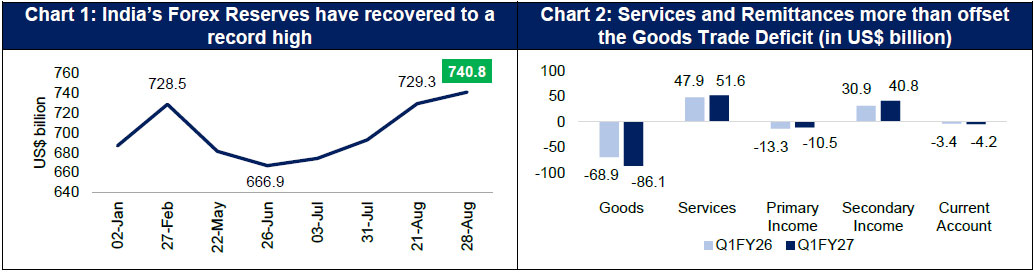
Net invisibles, led by services exports and remittances, have covered a steadily rising share of India’s goods trade deficit – from 55% in FY13 to 92% in FY26 – reaching 95% in Q1FY27 and keeping the CAD at just 0.5% of GDP (Table 1). Merchandise exports have also picked up meaningfully, rising 17.0% Year-over-Year (YoY) to US$173.78 billion in April- July 2026 (Ministry of Commerce and Industry).
As of FY26, CAD as a percentage of GDP sat at 0.6%. As per RBI, every US$10/bbl rise in crude oil prices adds about 0.5 percentage points to the CAD. On this basis, an increase in average Brent Crude Oil from US$69.04/bbl in FY26 to US$100/bbl could take the CAD to about ~2.1% of GDP in FY27, which is still manageable compared to earlier periods of pressure (Table 1).
Capital Account – FCNR(B) Inflows to strengthen the position in FY27
The Capital Account was the main source of pressure in FY26, with the surplus falling to US$6.0 billion from US$89.5 billion in FY24 as FPI (Foreign Portfolio Investors) flows turned negative (Table 1). However, the tide has started to turn in FY27 with the RBI’s USD-INR swap facility (introduced on June 08, 2026). Since Q1FY27, banks mobilised US$127.2 billion of FCNR(B) deposits under the RBI’s swap facility (June 08-August 31, 2026), with total inflows under the facility reaching US$136.4 billion. As a result, these inflows lifted India’s forex reserves to a record US$740.8 billion as of August 28, 2026.
Conclusion
India’s External Accounts seem to be remain comfortable on both the Current and Capital Accounts despite the recent disruptions, supported by structural factors that have reduced the potential sensitivity of the Indian economy to oil:
- Crude oil imports have fallen from about 8.5% of GDP in 2012 to about 4.8% in 2025, and short-term external debt from 33.1% to 21.6% of forex reserves between March 2013 and March 2026.
- The CAD remains well below earlier periods of pressure, backed by US$127.2 billion of FCNR(B) inflows, record forex reserves and a resilient banking system (RBI Financial Stability Report, June 2026).
- The RBI estimates a 10% rise in crude prices would add 30 bps to inflation and cut growth by 15 bps, which is a manageable impact given these buffers.
The key risks of a prolonged period of crude > US$100/bbl are: (1) widening CAD, (2) higher inflation, (3) lower USD-INR exchange rate, (4) slower remittances from Middle East (38% of India’s total), and (5) pressure on Capital Account through FPI outflows. With FCNR(B) deposits repayable on maturity, continued growth in services exports and FDI remains key.
Crude oil prices have already proved volatile through 2026, with Brent having fallen by 38.6% from US$118.35/bbl in March to US$72.63/bbl by June 2026 after the US-Iran Memorandum of Understanding, and rising up again to cross US$100/bbl again in September 2026 as tensions resurfaced. While such swings could continue if the conflict persists, India’s external position seems far better placed to absorb them than in past episodes of stress, backed by a decade of falling oil intensity, deepening invisibles, stronger reserves and renewed capital inflows.
Source: hdfcfund