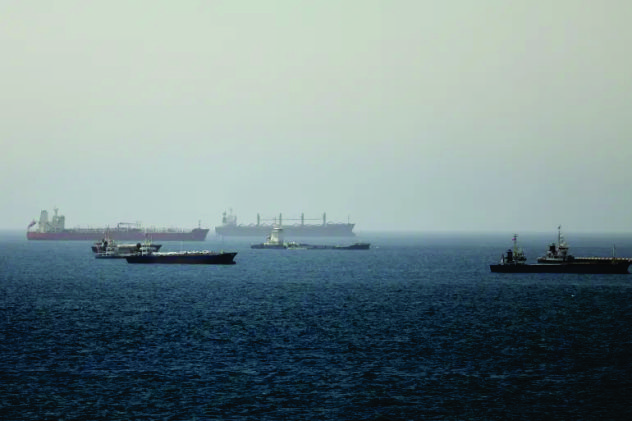
Shipping in the Strait of Hormuz has plunged following Iran’s announcement that it has closed the waterway once again over Israel’s strikes on Lebanon, according to ship tracking data.
A total of 12 vessels crossed the strait on Sunday, down from 35 transits the previous day, an analysis by maritime intelligence company Windward showed on Sunday.
Five of eight vessels entering the strait had their Automatic Identification Systems (AIS) turned off, according to Windward.
“The current traffic profile: dark, sanctioned, Iranian-linked, resembling the late-blockade baseline more than a functioning open strait,” Windward said in a post on X.
Maritime traffic in the strait had been showing signs of recovery since US President Donald Trump and Iranian President Masoud Pezeshkian on Wednesday signed a memorandum of understanding on ending the US-Israel war on Iran.
Twenty-five vessels transited the strait on Thursday, the highest number since mid-April, according to data from maritime intelligence provider Kpler.
Iran’s Islamic Revolutionary Guard Corps on Saturday declared the waterway shut, citing Israeli “crimes” in Lebanon and the failure of the US to maintain a ceasefire in the country.
US Central Command (CENTCOM) on Saturday denied that Iran had closed the strait, which normally carries about one-fifth of global oil and liquified natural gas supplies, saying that safe passage through the waterway remained “intact”, with 55 merchant ships transiting that day.
The cause of the discrepancy between the transit figures provided by CENTCOM and commercial ship tracking providers is unclear.
Behrouz Bakhtiari, a supply chain management expert at McMaster University in Hamilton, Canada, said the discrepancy could possibly be the result of the US military reporting “visible plus invisible passages”.
“While Iran is incentivised to claim that the traffic has been thinned – and it has – CENTCOM is incentivised to claim that the impact of Iran’s re-closure has not been significant, and hence the higher number. It is important to note that CENTCOM number cannot be verified, but that does not necessarily make it incorrect.”
US and Iranian negotiators on Sunday held make-or-break talks in Switzerland as the conflict in Lebanon threatened to derail efforts to turn their 60-day ceasefire extension into a permanent peace deal.
Despite renewed tensions between Washington and Tehran and signs of slowing traffic in the strait, oil prices moved lower on Monday morning in Asia.
Brent crude, the primary international benchmark, was down about 0.9 percent as of 01:30 GMT, at just below $80 a barrel.
Asia’s major stock markets opened higher, with key indices in Japan, South Korea and Taiwan making substantial gains.
Tokyo’s Nikkei 225 and Seoul’s Kospi were up 1.8 percent and 1.5 percent, respectively, while the Taiex in Taipei surged 2.6 percent.
Source: aljazeera