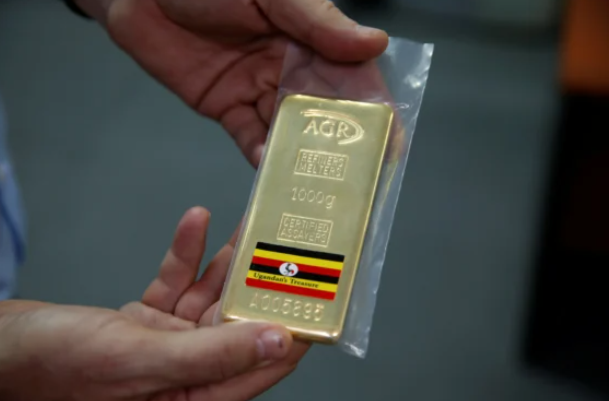
Uganda’s gold export earnings more than doubled to $8.9 billion in the fiscal year ended June, as shipment volumes increased sharply, raising renewed questions about the origin of the gold moving through the country’s trading and refining networks.
The East African nation exported gold worth $8.9 billion in the 12 months ended June, compared with $4.2 billion in the preceding fiscal year, according to a finance ministry report released late Monday.
Export volumes reached 70,088.99 kilograms, representing a 42.8% increase from the previous period. The growth in both value and volume points to a substantial expansion in Uganda’s recorded gold trade over the reporting period.
However, the increase has drawn scrutiny because Uganda’s domestic gold production is relatively small compared with the volume of exports recorded.
According to a Reuters report, an industry participant said domestic production could not account for the scale of the increase, suggesting that larger volumes of gold smuggled across the border from the Democratic Republic of Congo may be entering Uganda’s export channels.
The allegation has renewed attention on the role of regional refining and trading networks in the movement of gold from conflict-affected areas of eastern Congo into international markets.
Congo supply raises questions over export growth
The discrepancy between Uganda’s domestic production and its reported export volumes has become a central issue in assessing the country’s expanding gold trade.
The industry participant cited by Reuters said the increase in shipments could be explained by greater volumes of smuggled gold originating in Congo. The claim points to the possibility that Uganda’s export figures include significant quantities of gold produced outside its borders.
Ugandan authorities have previously rejected allegations that Congolese gold is smuggled through the country. They have maintained that gold processed and traded in Uganda is sourced legitimately.
The competing accounts highlight the difficulty of establishing the origin of gold as it moves through cross-border trading networks, particularly where production, aggregation, refining and export activities take place in different jurisdictions.
Investigative report highlights trafficking networks
The latest scrutiny follows a report published last month by The Sentry, a US-based investigative organisation that tracks violent conflict and illicit financial networks.
The organisation said a Uganda-based rebel group operating in Congo generates most of its revenue from gold trafficked through refining and export networks in Uganda.
The findings add to concerns about the potential links between gold trading, armed groups and cross-border financial networks in the Great Lakes region.
The allegations also raise questions about the effectiveness of supply-chain due diligence and the ability of regulators and industry participants to verify the origin of gold entering formal export channels.
Regional gold trade faces greater scrutiny
Uganda’s position as a refining and export hub places its gold sector within a wider regional supply chain connecting mineral-producing areas in eastern Congo to international markets.
The sharp increase in reported shipments could reflect changes in trading activity, supply flows and the volumes passing through the country’s refining and export infrastructure. However, the available figures do not independently establish how much of the exported gold was produced domestically or sourced from neighbouring countries.
The distinction is important for assessing the economic contribution of Uganda’s gold sector, as well as the effectiveness of measures intended to prevent the trade in minerals linked to armed groups.
The distinction is important for assessing the economic contribution of Uganda’s gold sector, as well as the effectiveness of measures intended to prevent the trade in minerals linked to armed groups.
For now, the finance ministry’s figures establish the scale of the increase in recorded exports, while the origin of the additional gold remains contested. Further clarity will depend on production data, traceability records and the ability of authorities to demonstrate that gold entering the country’s export networks has been legitimately sourced.
Source: Africaneconomyinc